
Is the metaverse still relevant?

Five years after the metaverse hype of 2021 is the metaverse still a useful concept? Or, is its usefulness like a weathered roadside motel, soiled by association, that should be forgotten to make space for a more appropriate concept?
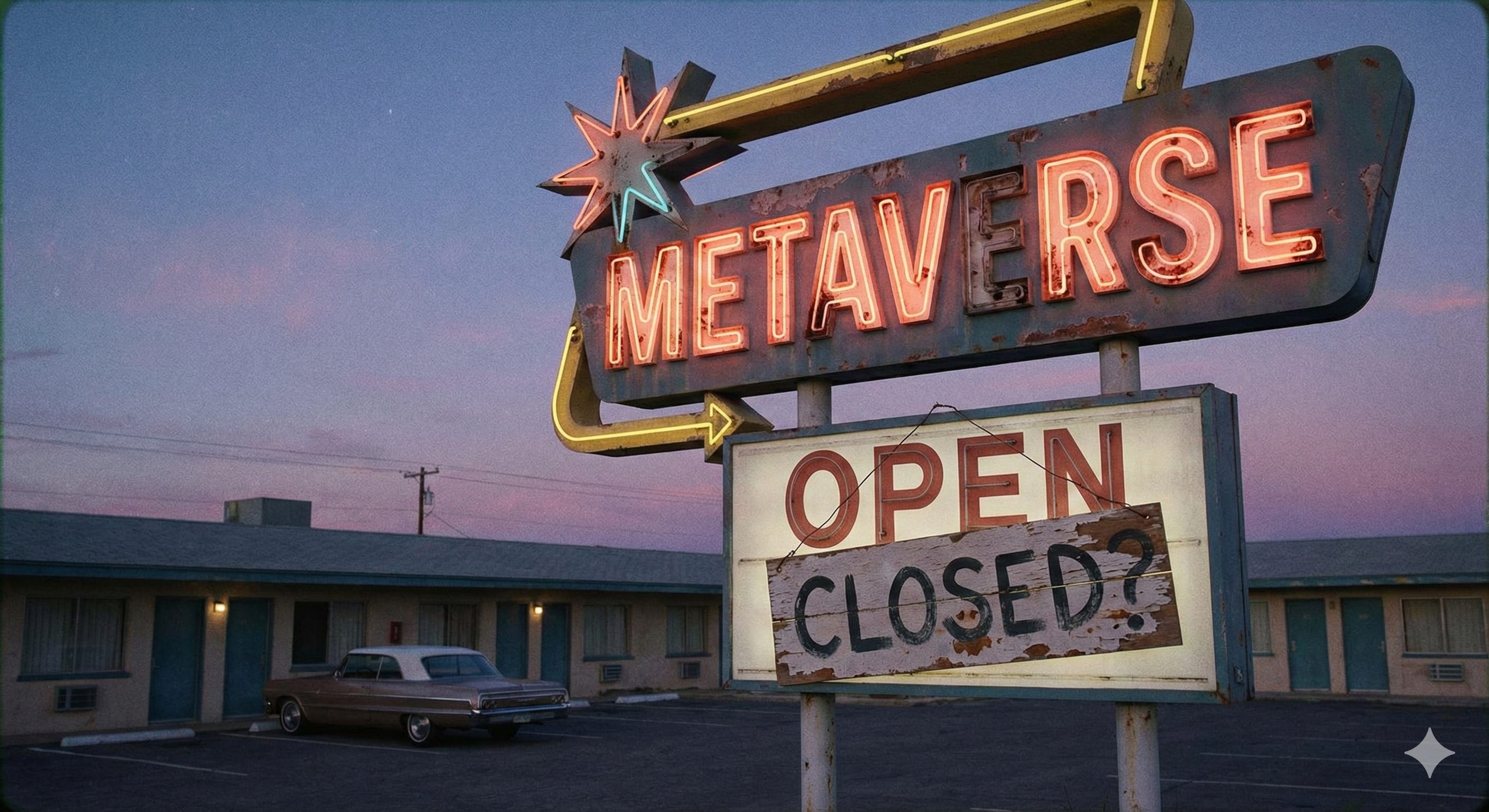
A prime problem with the metaverse is that the term was too often associated with blockchain, crypto, and grifters trying to cash in on emerging technology. Others were skeptical of Zuckerberg’s vision of the future and the rebranding of Facebook to Meta.
Here’s Matthew Ball’s extended definition of the metaverse (Ball, The Metaverse: And How It Will Revolutionize Everything, p29, 2022):
“A massively scaled and interoperable network of real-time rendered 3D virtual worlds that can be experienced synchronously and persistently by an effectively unlimited number of users with an individual sense of presence, and with continuity of data, such as identity, history, entitlements, objects, communications, and payments.”
Yeah, that’s a mouthful but it’s easier to say one word: metaverse. Yet, I do feel a certain ick when using that word. I’m wondering if I should rename this Substack.
My own working definition of the metaverse is a 3D world that allows you to step into the story.
That doesn’t capture all the uses wrapped into Ball’s lengthy definition. But I’m not focused on every aspect of real-time 3D.
My interests are in the experiences made possible through open standards of mixed and virtual reality. The emphasis on experiences is because I’m more fascinated by our imaginary lives than the enabling tools.
These tools are projecting images in front of our field of view. (Sound may also be a part of the experience.) We can reach out and touch the aspects of our view in ways not enabled through keyboard and mouse. What impact does this imaginary presence have on how we think?
We want to know nothing of the image but what reflection can teach us.
—Jean-Paul Sartre, The Imaginary (1940)
Where are all the technical developments heading, where are they converging? My X feed is filled with news mostly about world models, Gaussian splats, AI films, and robotics. The future of our imagination is embedded in all that’s happening.
The challenge with any analysis is not explaining the technical developments but the unknowns in when a company can bring a technology-based product to market.
Tools only exist to create experiences that will, in some way, be monetized by providing value to people.
Tools are not uniquely tied to the concept of the metaverse. But many of the tools and approaches (like world models, AI video generation, procedural content generation, and scene graphs) are essential for stepping into a dynamic imaginary storyworld.
The 21st Century is becoming more chaotic than we imagined. What we do know is that changes in technology, driven by AI, are not stopping. Will the metaverse be a part of that? Advances in computer vision, world models, and optical engineering indicate that those fundamental technologies will continue to produce tools that to come to market as products and experiences. Maybe those experiences will be niche and not the next computing platform that replaces smartphones. But niche experiences have value and a market.
Unless you work within a sector of an industry, you might not think about segments of an industry. Let’s use the hospitality industry as an example. In the 21st Century, are motels (as distinct from hotels, mostly for their drive-up-to-your-room feature and lower costs) still relevant?
The Super 8 hotel in the Virginia town where I lived is being razed to make way for a Sheetz. (And, wow, convenience stores have changed in the last couple of decades.) The older Motel 6 down the road is likely not long for this world, either.
But hotels remain very relevant and used by millions of people every night. The metaverse may go the way of motels, but the enabling functionality will thrive in products used by millions.