Notes from X (& elsewhere)
on World Models, Simulation & Games

I’m working on an essay about world models & emergent gameplay experiences. At this stage, I’m gathering notes and sources that I’m sharing below.
I could just have ChatGPT or Claude spit out an essay but I wouldn’t learn anything that way. I spend hours every day with those tools but sometimes you need to slow down.
A slow-paced literature review allows for ideas to turn over and settle in your mind. These thoughts form mental relationships, revealing connections that might find expression as insights in an essay.
With world models in 2026, I’m interested in two questions:
will world models replace game engines?
how can world models simulate social dynamics?
An excellent starting point is an article updated in December 2025: Ding, Jingtao, et al. “Understanding world or predicting future? a comprehensive survey of world models.” ACM Computing Surveys 58.3 (2025): 1-38. That survey also has a GitHub repo: https://github.com/tsinghua-fib-lab/World-Model with graphics and pointers to other repos of code and publications.
Not all of the 300+ citations tracked in that survey are of interest to me. While a major use use of world models is in robotics, I’m deliberately excluding robotics and embodied AI from the scope of my interests.
My reading process lately is to eyeball each page of an article, which is a preliminary habit I’ve always employed before reading anything that’s non-fiction. Then, I have Michael Caine read the article to me.
Did that cause you to pause?
Take a look at ElevenReader and watch this:
It’s a bit disconcerting to hear the 92-year old actor talk so articulately about AI. (I’m assuming ElevenLabs paid a load of cash to license that voice.) Anyway, hearing a quality voice reading a complicated text to me is another level of absorbing the information.
In the Ding, et al, survey, I identified a few dozen out of the hundreds of sources covered that might be of interest to me. That survey also has been cited more than 100 times in other publications. The survey was first released in December 2024, with updates in mid-2025 and the end of 2025.
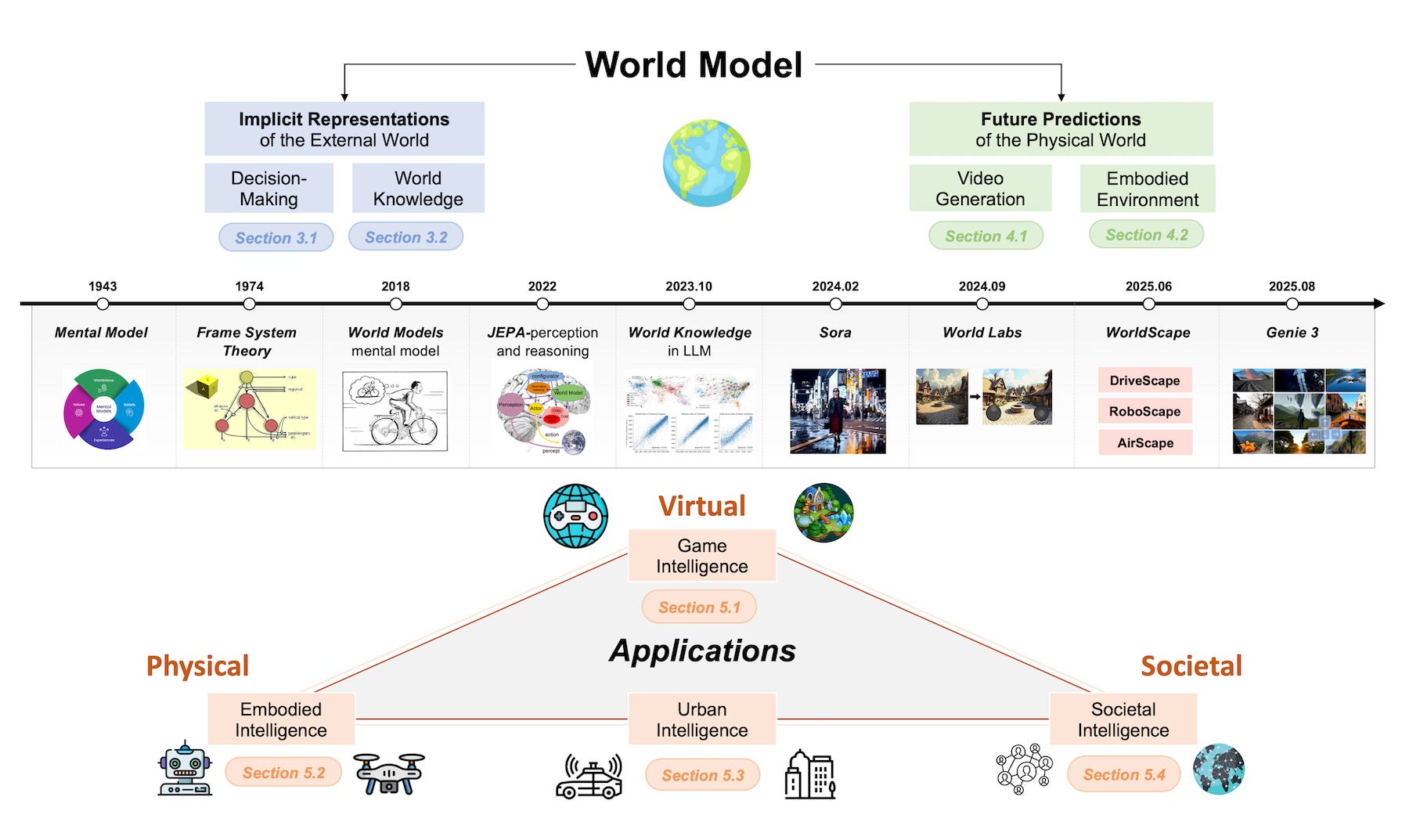
From the above diagram, you see how they define the two aspects of world models as
implicit representation of the external world
future predictions of the physical world.
From the applications section of the diagram (the bottom part), my interests are in the virtual and societal applications.
At this point, I still have dozens of papers on world models that I want to review. I won’t read most of them closely. I’m looking for things that really stand out relevant to my interests.
I’ve been talking a lot with my high school kid about the process of research and am trying to model that process for her; on one of the 3 desks in my home office, I have colored-coded index cards scribbled with notes. (All 3 desks are for my use, though I let her use one when she’s studying with me.)
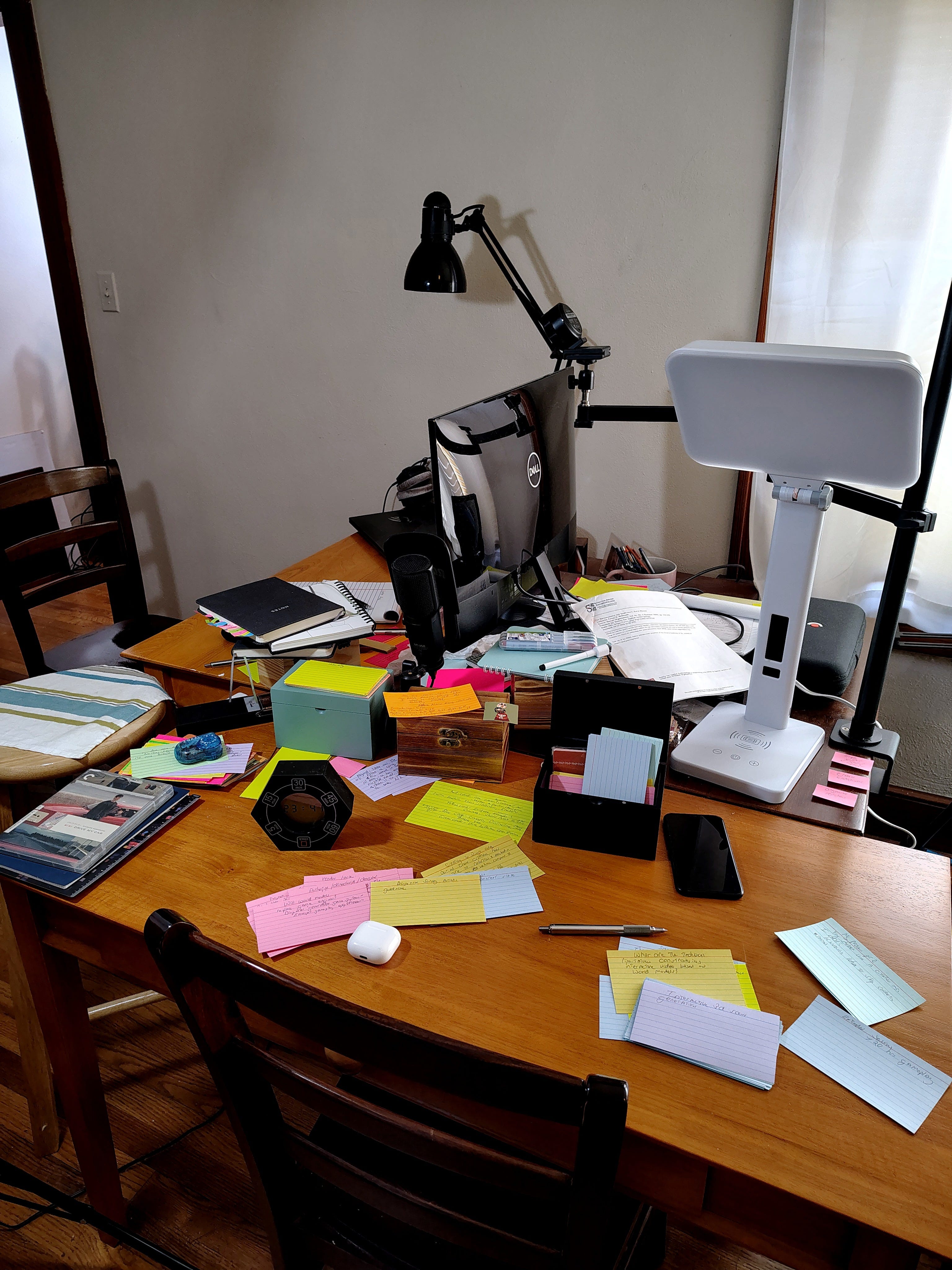
Once I have a grasp on the topic, I will then turn to AI tools for another perspective. But I don’t want to do that too early in this process. Before working with Claude and NotebookLM on this topic, I’ll review what has come across my X feed lately.
X is the best way to stay current with very recent developments in AI. It seems that most AI researchers post regularly on X (with the exception of Yann LeCun, who seems to have had enough of Elon, and primarily posts on LinkedIn). If you’re getting started on X with the intention of tracking X developments, the best approach is to follow some of the lists curated by Robert Scoble. Be aware of the many fraudsters on X posting about their one-shot marvels or their undisclosed shilling for specific companies. (I almost wrote “unscrupulous companies” but that would seemingly entail most of capitalism at this point.)
Context: On game engines and world models
Here are some key insights recently from X.
Tim Sweeney, founder and CEO of Epic Games, maker of Unreal Engine:

As providers of world models are highlighting their ability to generate games, the evolving nature of world models have a direct impact on Epic’s future. Epic’s Unreal Engine is the single most complex (and fascinating) software I’ve ever used. AI assisted tools will make developing in UE easier. The integration of world models with game engines will unlock significant advances in not only gameplay but also any form of simulation. Game engines are used for much more than creating games.

That clip from his post cuts off the 2nd and 3rd paragraphs:
What would the ideal kind of memory be? It would be essentially a scene graph (James Clark, 1976!) hierarchically describing all of the objects in a world together with their properties, in a way that’s easy to query and operate on.
This is the reason for the core thesis that the ideal evolutionary path sees a merging of world models and engines, the AI side providing vast amounts of loosely organized audiovisual and textual knowledge, and the engine providing consistent reproducible data representation and simulation.
I have another upcoming post in the works about scene graphs.
Jacob Sansbury, developer/entrepreneur:

Click through on that post. He goes on to write about a point that I think is on target:
Medium-term is where it gets interesting. Add sound generation, longer context, more control and you have something Netflix should be terrified of. Imagine exploring Westeros between seasons. Wandering the Stranger Things universe. That’s a real product, and it’s coming.
But that’s interactive storytelling.
Gamers play because it’s fun to get better at something. Progression systems. Mechanical mastery. Nostalgia, where things work exactly how they always worked. They sink months into a single title. Years. And here’s the thing: they mostly don’t care about graphics or narrative.
Every single one of these motivations sits at the exact weak spot of world models.
Games require determinism. Multiplayer needs every client to agree on physics, every frame. Speedrunners need frame-perfect consistency across thousands of attempts. Competitive play needs rules that don’t drift. You can’t have ranked when reality is probabilistic.
World models are competing with passive media.
Long-term, they’ll probably eat the renderer. Generating pixels instead of rasterizing triangles. But game logic, systems, authored constraints? That’s a different problem entirely.
He’s wrong about the renderer part but it’s all comes down to how the pixels are generated.
The Marketplace: World Models are Coming Everywhere
Everybody seems to be releasing world models in 2026. I’m not going to list every announcement. World Labs, because of the quality of their team, is a company I’m keeping an eye on. Here’s a good essay from Fei-Fei Li on spatial intelligence.
Martin Casado is posting a lot about world models, 3D scene generation and games:


But he’s also a general partner at Andreessen Horowitz, an investor in World Labs. In the last decade, I noticed that VCs have become adept marketers of the companies in their portfolio.
The first time I ever learned about venture capital was in high school in the early 1980s. I lived near Nashville and the newspaper ran a profile on a local (Jack Massey), who was actually quite a major figure in venture capital at that time. But I always got the feeling then that these guys (Massey and Lucious Burch III) kept a low profile compared to today’s VC firms that are all over the media with their dedicated YouTube channels and podcasts. But this is a different era.
David Baszucki is the founder and CEO of Roblox, which is a company I first learned about a while back when my daughter was about 8 years old. She told me about Roblox.


Roblox is a company to watch. Hook the kids on your product; those kids eventually become adults with a disposable income of their own. The music industry has known that for years.
Runway is the company in this space that has the best aesthetic sensibility. Co-founder and CEO Cristóbal Valenzuela maintains an excellent X account. Runway’s focus, for now, is on AI films. But their use of video generation is an essential element of how I’m thinking about world models.

Take a look at Valenzuela’s essay from last year on It's All About The Pixel Economy (Or Why You Might Be Optimizing for the Wrong Future)
And the thing about everybody’s doing world models. Here’s a post from VP for AI at AMD:

Research: The Technical View behind World Models
But what are these world models really doing?
Jim Fan, NVIDIA Director of Robotics and Distinguished Scientist published an “article” on X where he describes world modeling as the next paradigm shift:

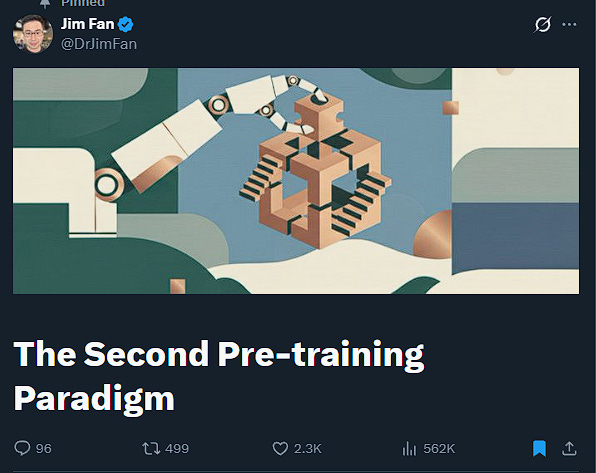
Very few understand how far-reaching this shift is, because unfortunately, the most hyped use case of world models right now is AI video slop (and coming up, game slop). I bet with full confidence that 2026 will mark the first year that Large World Models lay real foundations for robotics, and for multimodal AI more broadly.
That article is an excellent short introduction to world models in 2026 and explains how all this video generation relates to robotics.
He notes the key question:
Is pixel reconstruction really the best objective, or shall we go into alternative latent spaces?
That comprehensive survey by Ding, et al, points to articles on the technical nature of world models.
That’s why you also need to follow Yann LeCun on LinkedIn, who explains “that a proper world model is not a video generation system.”
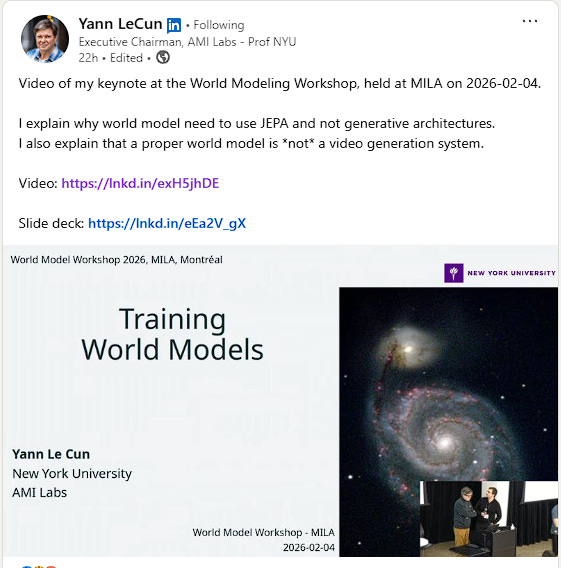
That link goes to an 8-hour video. LeCun’s talk starts at 5:42.47
That workshop starts with a talk and Q&A session with Jürgen Schmidhuber, who co-wrote a foundational paper on world models. I wrote about Schmidhuber in my earlier post on world models. You can’t talk about world models without talking about Schmidhuber. (And Schmidhuber will remind you of that if you do so.)
On Feb 7, 2026 on X, Yann LeCun posted: “Anyone with an interest in world models should watch this”
“This” is this:


Malik’s presentation starts at the 1 hour, 4 minute mark.
Next steps
Some of that material I’ve already looked at closely. Other parts I’m going to look at more closely. Some I will put aside. Some of you may wonder why don’t I just drop that all into something like NotebookLM? That will be interesting, and I will do that at some point. A big question for this process is whether you start with an analysis done by an LLM or if you engage with an LLM while you read (or watch) or afterwards?
There’s not a best answer to that. It depends upon your goals, i.e., why are you handling this material in the first place? How deep into certain areas of knowledge do you want to go and for what purposes?
I probably take the middle ground and utilize Claude as well as NotebookLM as a reading partner to help me track what I’m learning. Ultimately, the only way I’m going to know if I have absorbed this topic is if I can comfortably express the concepts in my own words, connect those concepts to my own work, and articulate the insights I have gained from those connections.
Go back to the photo of my messy office. Those colored index cards are where I write (by hand) my thoughts that will (by reassembling the index cards) form an essay.
That’s a very different process than the one I used to write this long, and a bit rambling, post on the sources I’m gathering. This post is more than 2,500 words of free association that I typed directly into Substack at my stand-up desk over four hours on a Sunday. Is this a waste of time? Not for me. This is my life.